
BALLISTIC STANDARDS
Understanding bullet-resistant glass levels and ballistic glass ratings is essential for selecting the right protection. The two primary standards, UL 752 and NIJ 0108.01, classify ballistic resistance based on ammunition type, velocity, and threat level. This guide explains bulletproof glass levels and how to specify the right protection for your facility.
The most common ballistic standards are the Underwriter’s Laboratories (UL) UL 752 and the National Institute of Justice (NIJ)’s 0108.01. Typically, UL 752 is the most common standard used because it is designed specifically for building product, whereas the NIJ standard was originally developed for law enforcement body armor and equipment. UL 752 also considers the penetration as well as injuries that could be caused by the spall from ballistic penetration.
When ordering products, it’s important to specify the required degree of ballistic protection you need.
The Need for Bullet-Resistant Products and Ballistic Standards
The ratings for bullet-resistant glass are determined based on the protection the ballistic-rated system delivers. This is based on the velocity, size and number of rounds fired before it breaks, typically determined as a result of the weapon used. The projectiles fired by high-caliber, high-velocity weapons deliver the greatest amount of force to the target. This requires stronger bullet-resistant glass, which offers a higher capacity for absorbing energy from the projectile.
To be at the highest bulletproof glass rating, the entirety of the system, including the glazing material, frame, and anchors, must be capable of absorbing force from the projectiles. Simply having bulletproof glass installed in the framing system is not enough. The entire system must be rated high enough to ensure the maximum level of protection.
UL 752 11th Edition
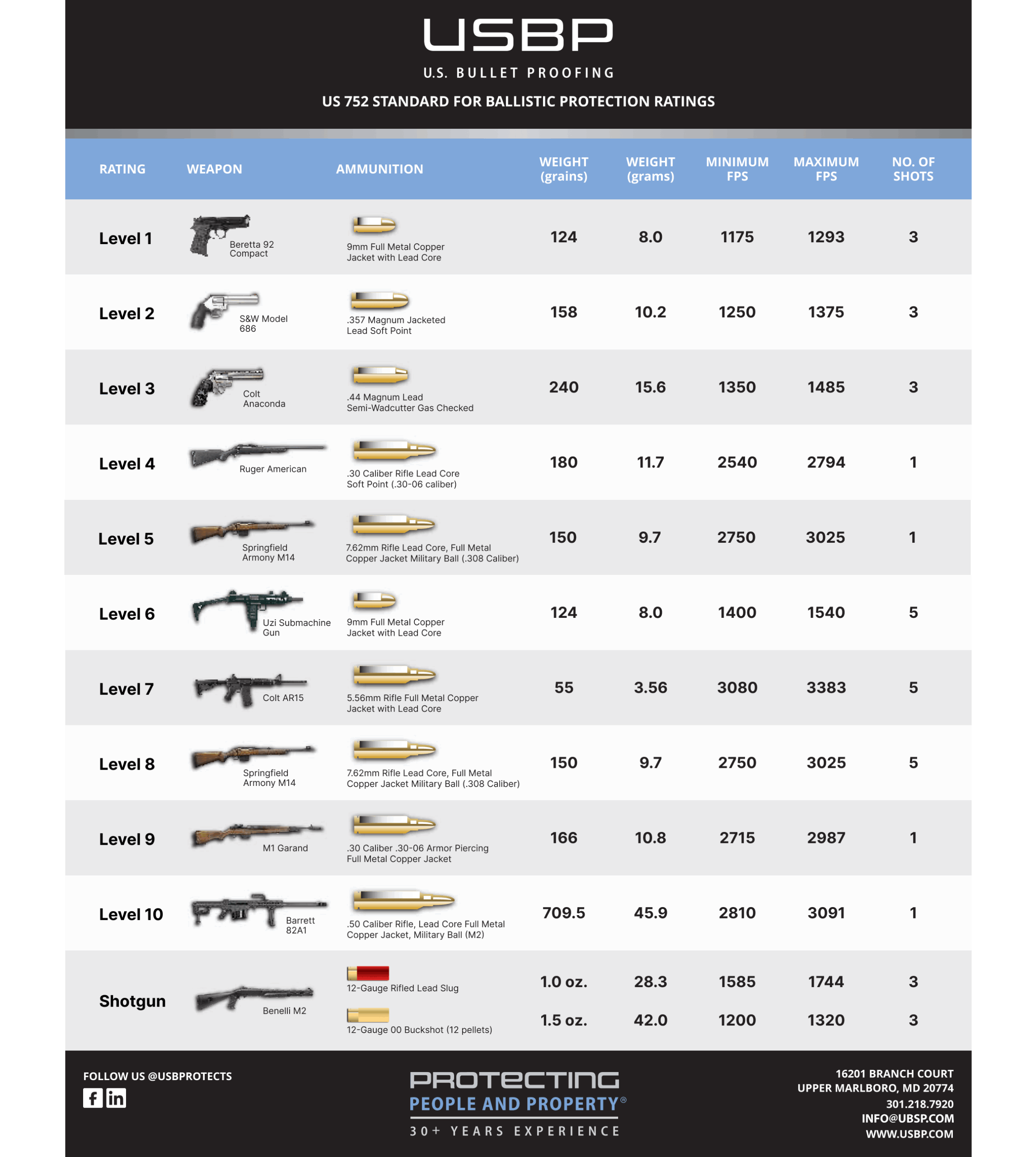
The UL 752 11th edition is the most common industry standard used today. It involves separating bullet-resistant ratings into numeric levels, Level 1 through Level 8, with each ballistic glass rating corresponding to specific ammunition threats. The details below give you a closer look at how UL 752 standards in the 11th edition work:
- Level 1 Rating: Provides protection from small caliber handguns up to 9mm and is often used for gas stations, transaction windows, retail and convenience stores, and pharmacies.
- Level 2 Rating: Provides protection from large caliber handguns up to .357 Magnum and is commonly used in financial institutions such as banks, credit unions, and check cashing businesses.
- Level 3 Rating: Provides protection from large bore, large caliber handguns up to .44 Magnum, and is frequently specified in high-risk and high-occupancy public buildings, including schools and government facilities, as well as law enforcement, courthouse, and prisons.
- Level 4 Rating: Provides protection against one shot from a .30-06 rifle loaded with 180-grain soft point bullets, moving at approximately 2,540 feet per second. This rating is appropriate for sensitive security locations and government facilities facing high-powered rifle threats.
- Level 5 Rating: Provides protection against one shot from a 7.62mm rifle using lead core full metal copper jacket military ball ammunition at about 2,750 feet per second. This level is relevant for facilities exposed to military-grade rifles.
- Level 6 Rating: Provides protection against five shots of an Uzi 9mm submachine gun (124-grain full metal copper jacket with lead core bullets) fired at approximately 1,400 feet per second. This rating is used where rapid-fire handgun threats are a concern.
- Level 7 Rating: Provides protection against five shots from a 5.56mm rifle, such as an AR-15, using full metal copper jacket lead core (55-grain) bullets at roughly 3,080 feet per second. Suitable for high security operations centers and critical infrastructure sites.
- Level 8 Rating: Provides protection against five shots of 7.62mm rifle (308 Winchester/150-grain full metal copper jacket with lead core bullets), fired at around 2,750 feet per second. Level 8 is considered one of the highest practical levels for commercial and governmental use.
A proper threat and risk assessment will help determine what level of protection your organization needs according to the UL 752 standard. Consulting with our team early in a project can save time, money, and ensure the glass, walls, and frames in your facility match the security requirements necessary to protect it.
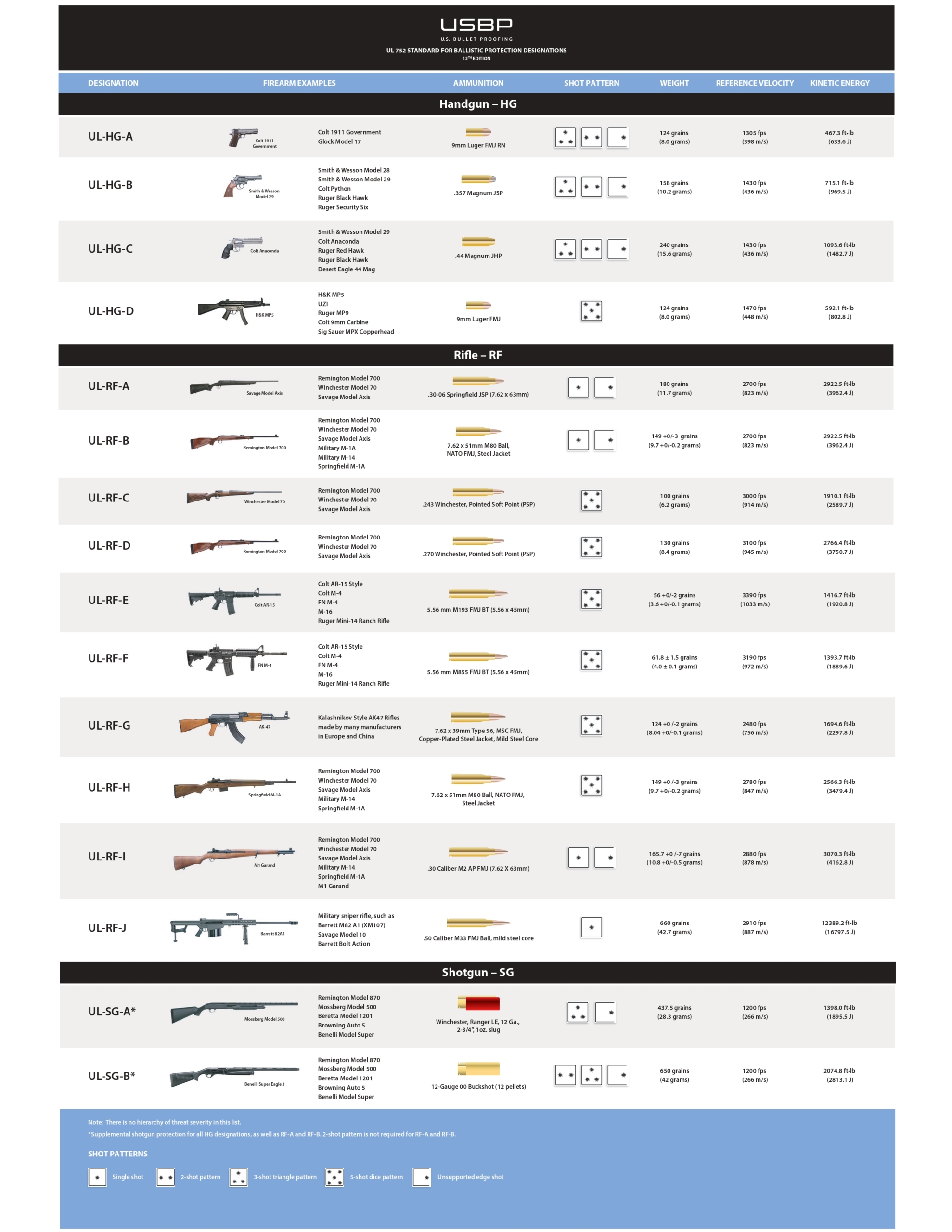
The recently introduced 12th edition of the UL 752 standard marks a significant leap forward in ensuring the integrity and reliability of protective materials. The 12th edition standard was developed because it addresses critical inconsistencies found in previous versions, providing clearer, more in-depth guidelines for manufacturers and greater assurance for end-users.
A key difference from the 11th edition is the departure from a hierarchical rating system. The 12th edition now employs distinct, non-hierarchical classifications for handguns (HG), rifles (RF), and shotguns (SG), categorizing them based on ammunition type and ballistic characteristics. This change eliminates previous ambiguities where a higher rating didn’t always guarantee protection against all lower-rated threats.
The 12th edition also introduces vastly improved testing protocols. It mandates testing more samples of a material, with more shots per sample, and specifies more precise shot groupings. Using this methodology, along with its clear requirements for shot placement and sample conditioning, ensures our bullet-resistant systemsglass products are tested under the most realistic and demanding conditions, offering unparalleled protection when it is needed most.
While the 12th Edition of UL 752 introduces several updates aimed at improving security and reflecting changes in ballistic threats, it is still a relatively new standard and therefore has not gained widespread adoption as of yet.
The new edition also adjusts threat profiles and introduces additional standards for higher caliber and specialty rounds. Enhanced testing ensures that certified products are evaluated against the latest real-world threats, including armor-piercing ammunition and updated weapon types.
Handgun (HG) Levels
The designations for handun address increasing threats from handguns, covering common calibers:
- UL-HG-A: Protects against standard 9mm handgun rounds commonly encountered in civilian settings.
- UL-HG-B: Adds protection against more powerful handgun rounds, such as the .357 Magnum, for elevated threat environments.
- UL-HG-C: Designed to stop powerful handguns, including the .44 Magnum, making it suitable for environments facing higher-risk individuals.
- UL-HG-D: Provides protection against specialized and high-velocity handgun threats, including the 9mm Luger used for tactical training.
Rifle (RF) and Shotgun (SG) Levels
Destinations UL-RF-ARF through UL-RF-J and SG categories expand coverage to a range of rifles:
- UL-RF-A: Protects against a single shot from a .30-06 hunting rifle.
- UL-RF-B: Protects against a single shot from a 7.62mm military-style rifle.
- UL-RF-C: Provides protection against five shots from a .243 Winchester fired from rifles such as the Remington 700 or Winchester Model 70.
- UL-RF-D: Similar to UL-RF-C, but tested against a slightly heavier, higher-velocity projectile over five shots
- UL-RF-E: Protects against five shots of 5.56mm ammunition fired from platforms such as the Colt AR-15 or Colt M4.
- UL-RF-F: Similar to UL-RF-E but tested with a heavier 5.56mm projectile over five shots.
- UL-RF-G: Protects against five shots of 7.62mm ammunition fired from a Kalashnikov-style AK-47.
- UL-RF-H: Uses the same 7.62mm military-style ammunition as UL-RF-B but increases protection to five shots.
- UL-RF-I: Protects against a single shot of .30 caliber ammunition fired from rifles such as the Remington 700 or Winchester Model 70.
- UL-RF-J: Provides protection against a single shot of .50 caliber ammunition fired from a military sniper rifle.
The third and final category is for shotgun designations, which includes slug and buckshot shotgun shells.
- UL-SG-A: Protects against shotgun slugs—large, single-projectile rounds with significant penetrating power.
- UL-SG-B: Provides protection against standard 12-gauge buckshot loads containing multiple lead pellets
NIJ Standard 0108.01
The NIJ 0108.01 is a common ballistic resistance performance standard established by the National Institute of Justice (NIJ). It is a less common standard as it was intended for body armour.
NIJ Standard 0108.01 Ballistic Resistant Protective Materials
- AP – Armor Piercing
- LRHV – Long Rifle High Velocity
- FMJ – Full Metal Jacket
- RN – Round Nose
- JSP – Jacketed Soft Point
- SWC – Semi-Wadcutter
| ARMOR TYPE | TEST AMMUNITION | RQD. HITS PER SPECIMEN |
|---|---|---|
| I | LRHW Lead 38 Special RN Lead | 5 5 |
| II-A | 357 Magnum JSP 9mm FMJ | 5 5 |
| II | 357 Magnum JSP (higher velocity round) 9mm FMJ (higher velocity round) | 5 5 |
| III-A | 44 Magnum, LeadSWC Gas Checked 9mm FMJ | 5 5 |
| III | 7.62mm, 308Winchester FMJ | 5 |
| IV | 30-06 AP | 1 |
ASTM F3561-22 Standard
The ASTM F3561-22 standard is another new development in modern security. This standard evaluates a barrier’s ability to resist forced entry after it has been subjected to a simulated active shooter attack. It addresses a crucial real-world scenario where someone might shoot out a portion of a door or window to then gain access.
Unlike traditional ballistic standards, ASTM F3561-22 isn’t designed to stop bullets from passing through — it’s designed to ensure the assembly holds together after impact, preventing a physical breach. The goal is delay: keeping a barrier intact long enough for occupants to respond and first responders to arrive. Penetration is permitted under the standard, provided the glazing maintains its structural integrity and continues to resist forced entry.
Ballistic Glass Windows and Doors
U.S. Bullet Proofing understands the importance of Protecting People and Property®, which is why we’re committed to engineering and manufacturing elite bulletproof products.
Contrary to popular belief, bullets don’t bounce off ballistic glass windows. The multiple layers of reinforced glass gradually erode the velocity of the bullet, absorbing its kinetic energy and slowing it down enough that it doesn’t fully penetrate the window.
Our customized solutions serve a wide range of applications:
- Academic buildings: Create reinforced entry points to ensure the safety of students and educators including windows, doors and reception windows in the security vestibule or entrance to the building.
- Police stations: Incorporate high-level security solutions for front desks, interview rooms, and detention areas.
- Financial institutions: Depend on advanced ballistic solutions to protect tellers and assets from armed robbery.
- Pharmacies: Benefit from secure perimeters that safeguard medications and personnel from potential threats.
- Retail stores: Prevent smash-and-grab incidents and deter armed intruders from interfering with retail locations.
Reach Out to U.S. Bulletproofing for Product Details
U.S. Bullet Proofing is a pioneer in the design and supply of aluminum window and door systems that provide high-level protection from ballistics, blast, storm impact, and forced entry. Our job is Protecting People and Property®, and we take that responsibility seriously, as seen in the quality of products we provide, the scale at which we operate, and the breadth of projects that involve our solutions.
Contact one of our sales representatives to learn more about how we can help you with your next security project.
United States Bullet Proofing, Inc. is proud to supply the industry with the most advanced forced entry, bullet resistant, and blast resistant high security products.
The company was founded through sheer will and determination of a few people who believed that they could build the very best quality and features in the business at the most competitive price. Our job is Protecting People and Property®, and we take that responsibility very seriously as evident in the quality products we manufacture. Our products are in use around the world protecting officials in the highest levels of government and industry.

© Copyright - U.S. Bullet Proofing 2024